
3I/ATLAS: The Mysterious Interstellar Visitor Captivating the World
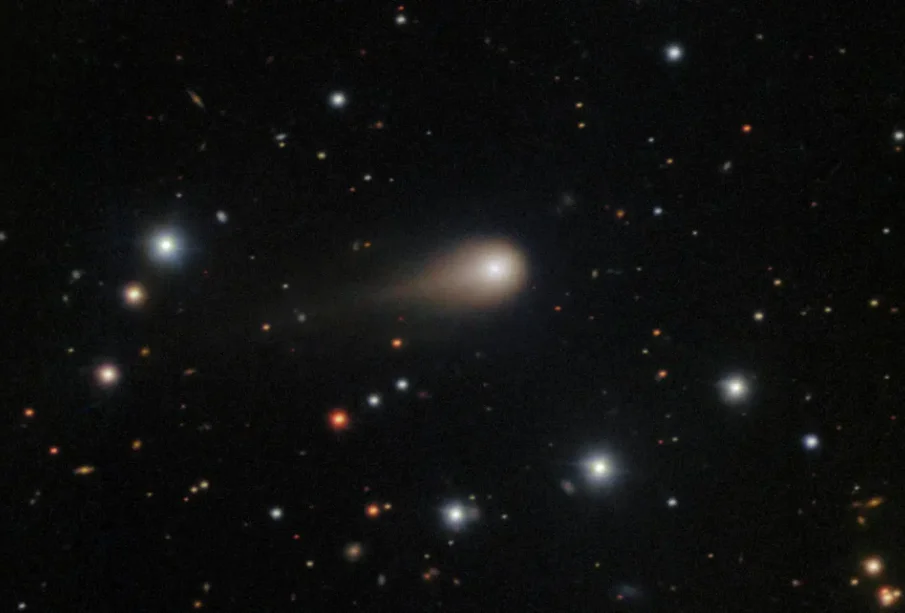
By Gerald Mackenzie
A mysterious celestial visitor from beyond our Solar System — known as 3I/ATLAS — is captivating scientists, space agencies, and the public alike. Discovered in July 2025 by the Asteroid Terrestrial-impact Last Alert System (ATLAS) in Chile, this fast-moving body has been officially confirmed as the third known interstellar object ever observed passing through our cosmic neighborhood.
Unlike any comet or asteroid seen before, 3I/ATLAS has already drawn global attention — not only for its scientific importance, but also for the unusual international monitoring efforts it has sparked, involving both American and Chinese satellites.
The object, formally designated 3I/ATLAS (C/2025 N1), follows a hyperbolic orbit, meaning it is not bound by the Sun’s gravity. In simpler terms, it came from another star system — and will never return.
Images from observatories and satellites reveal a bright coma and growing tail, similar to a comet, suggesting active outgassing as it nears the Sun. Yet its chemical makeup sets it apart. Early data from NASA and the European Space Agency indicate that the object’s emissions are unusually rich in carbon dioxide (CO₂) compared to water — a composition rarely seen in local comets.
“This is a time capsule from another planetary system,” said Dr. Leah Vargas of NASA’s Planetary Defense Office. “Every molecule we analyze tells us something about how planets form around other stars.”
For astronomers, 3I/ATLAS represents a once-in-a-generation opportunity. Only two interstellar visitors — ʻOumuamua in 2017 and 2I/Borisov in 2019 — have ever been observed before.
By studying its light, scientists can infer the chemistry of distant worlds and improve techniques for tracking fast-moving cosmic objects. The knowledge gained could strengthen Earth’s planetary-defense systems against asteroids or comets that might one day pose a threat.
As the object approached its closest point to the Sun this week, a coordinated network of observatories — from Hawaii to South Africa — joined the watch.
NASA and the U.S. Space Force have reportedly used Earth-orbiting and deep-space satellites to collect thermal and spectroscopic data. American intelligence satellites are also believed to be tracking the object’s trajectory for calibration tests.
Meanwhile, China’s National Space Administration confirmed that its Gaofen and Xuntian telescopes are conducting parallel imaging campaigns. Both nations insist the collaboration is scientific — not strategic — though experts note that such cross-monitoring could improve early-warning systems for future interstellar visitors.
Earlier this month, U.S. and European astronomers released images showing 3I/ATLAS passing near Mars. Some Chinese media outlets, however, published different frames appearing to show slight anomalies in brightness and motion. While speculation spread online about possible “maneuvering” or artificial origin, NASA scientists have dismissed such claims as optical artifacts caused by solar activity and imaging angles.
Despite public anxiety, experts stress that the comet’s path poses no threat to our planet. Its trajectory will take it well beyond Earth’s orbit after perihelion — the point of closest approach to the Sun — which occurred around October 29.
NASA estimates the object’s closest pass to Earth will still be more than 200 million miles away, making it a spectacle for telescopes, not a hazard.
Over the coming weeks, scientists expect 3I/ATLAS to fade from view as it heads back into interstellar space. Data from the James Webb Space Telescope, TESS, and multiple ground observatories will take months to fully analyze.
Yet for many, its brief appearance is a reminder of how vast and unpredictable our universe truly is.
“Each visitor from the stars challenges our understanding,” said Dr. Vargas. “And each one leaves us with the same question: what else is out there?”